What can truly be heard when the music stops and the instruments fall silent?
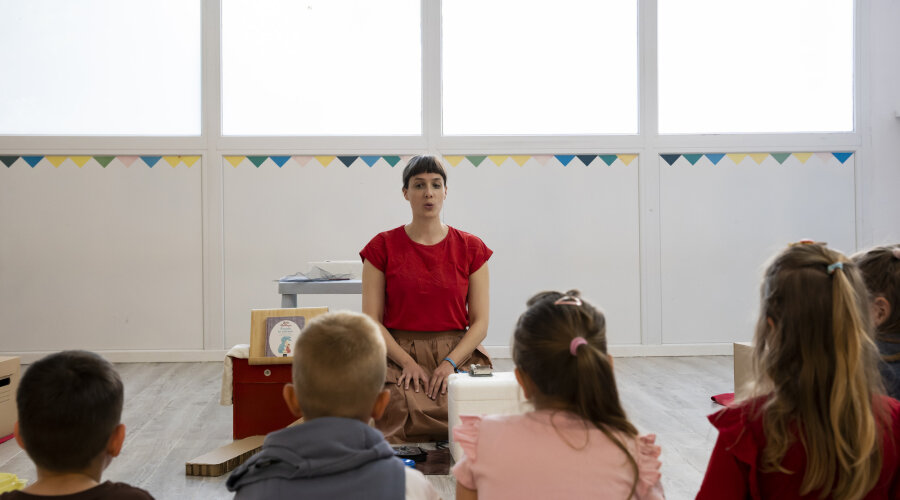
The interactive concert workshop "Echo" invites young explorers aged 4 to 7 on a sonic journey inspired by the visionary work of Alvin Lucier and John Cage. Through approximately thirty minutes of collective exploration and music-making, children will discover Cage’s great secret: silence does not really exist.
The central part of the workshop is inspired by the principle behind Lucier’s "Opera with Objects", in which ordinary everyday items such as boxes and bowls become unexpected “performers,” while pencils are transformed into musical instruments. Children will observe how these objects capture invisible sound waves and turn them into magical resonances, acting like sound detectives uncovering the hidden threads that connect objects and space. In this way, the entire room becomes a giant instrument, and each child becomes a conductor of invisible frequencies. The workshop aims to show young participants that the world is filled with sound and music even when it appears to be quiet, transforming the physics of sound into pure child’s play.
During her stay in Zagreb, on 19 May 2026 Kaja held the workshop "Sound and Echo" for children at the Creative day Kindergarten, introducing young participants to the world of experimental listening, sound exploration, and musical play.
Kaja Farszky (HR/BE), based in Brussels since 2016, is percussionist whose work is rooted in contemporary music and interdisciplinary collaborations reaching diverse age audiences, including babies. Her life is marked strongly through work with composers, artists from different fields such as dance, theatre, and visual arts while being involved in creations on a regular basis. She deeply questions the music that is played, and the context that is being put into. She uses percussion instruments to express herself, communicate, and touch physical and psychological dimensions of sound in order to expand the possibilities of contemporary music for creating bridges between audiences, disciplines, and (sound) environments. Kaja believes that percussion music at its best reveals and amplifies something fundamental about the composers and performers who engage in it.