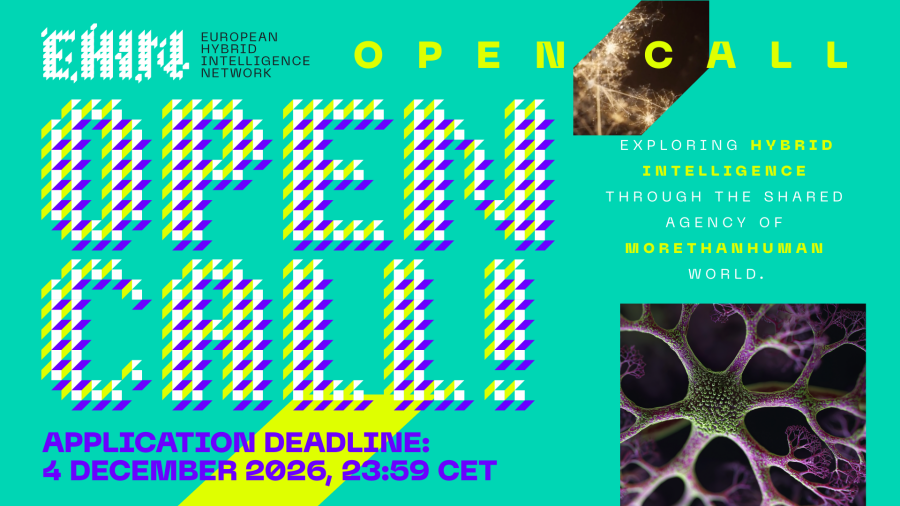
What happens when living systems, cutting-edge science, and artistic imagination collide? The European Hybrid Intelligence Network (EHIN) invites contemporary artists to step into this uncharted territory and redefine how we think about intelligence, data, and ecological connection. Through a powerful union of art, science, technology, and living systems, this open call opens the door to deeply collaborative research into how plants, fungi, microorganisms, and animals process information and respond to changing environments.
The European Hybrid Intelligence Network (EHIN) invites artists to apply for six residency opportunities exploring hybrid intelligence, biocomputing and the interdependence of living systems. EHIN brings artists into dialogue with scientists, engineers and local practitioners to investigate how living systems process information, respond to their environments and form complex ecological relationships. Applicants are invited to develop their own research-led proposal and choose the host institution whose expertise and facilities best fit their project.
The six hosts are the Center for the Promotion of Science (CPN) in Belgrade; GLUON in Brussels; Kersnikova Institute in Ljubljana; KONTEJNER in Zagreb; LABoral Centro de Arte y Creación Industrial in Gijón; and ZKM | Center for Art and Media Karlsruhe.
Please note: each applicant may submit one proposal to one host institution only. Applications to multiple hosts with the same proposal are not permitted.
Deadline: 4 December 2026, 23:59 CET
Residency period: February 2027–January 2028 (approximately 12 months)
Eligibility, support provided and application requirements: see Guide for applicants
Open call details and application: europeanhybridintelligencenetwork.eu/open-call/
Questions on the Open Call: Ramona Van Gansbeke (ramona@gluon.be)
Questions on the project: Jana Putrle Srdić (jana.putrle@kapelica.org)
For updates and project news, please visit EHIN webpage.
The European Hybrid Intelligence Network (EHIN) is co-funded by the European Union’s Creative Europe programme under grant agreement No. 10125651. Views and opinions expressed are those of the author(s) only and do not necessarily reflect those of the European Union or the European Education and Culture Executive Agency (EACEA). Neither the EU nor EACEA can be held responsible for them.