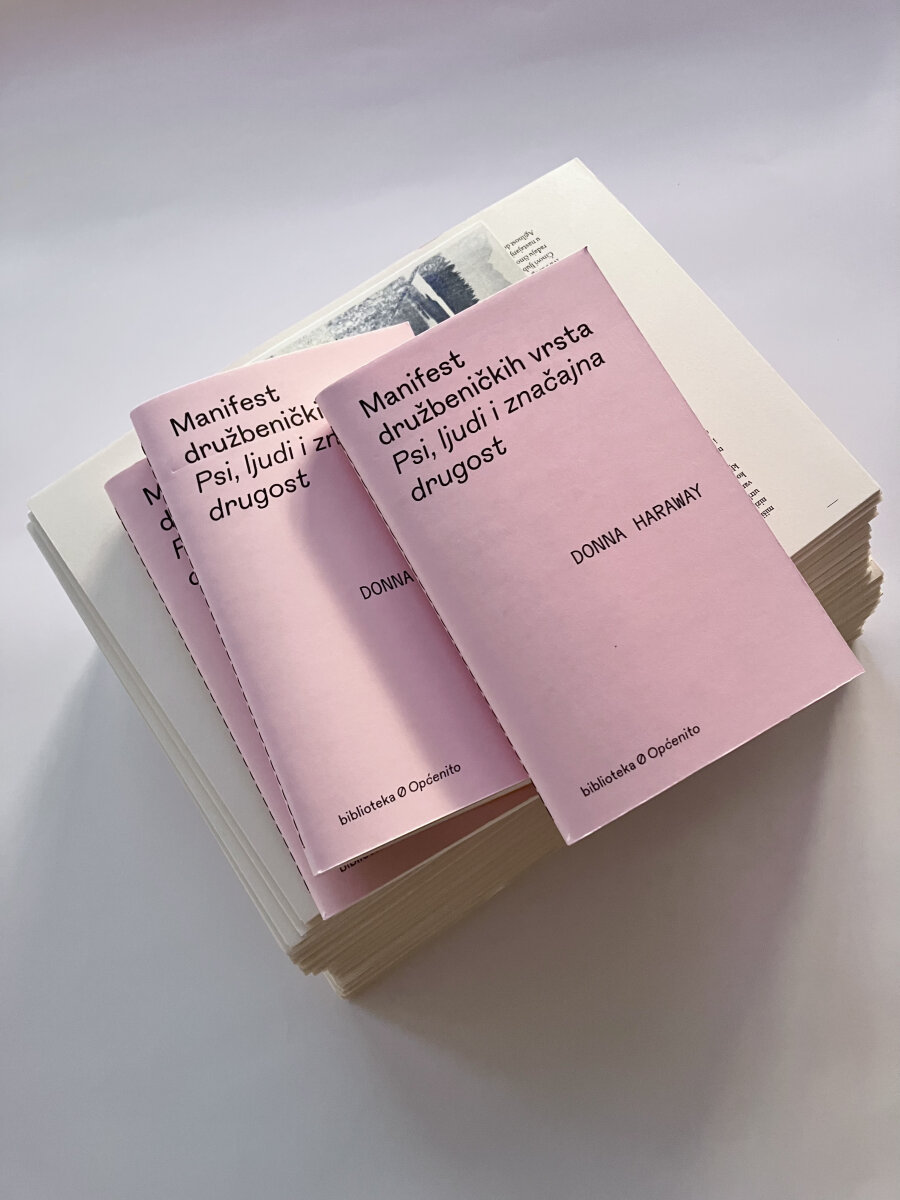
About “The Companion Species Manifesto: Dogs, People and Significant Otherness”
“The Companion Species Manifesto: Dogs, People and Significant Otherness” (2003) was preceded by the influential “A Cyborg Manifesto” (1985), in which the cyborg is not merely a metaphor for a technologically reconfigured body, but a political resource for thinking about identity beyond essentialist, binary and teleological narratives.
The recent translation published by Biblioteka 0 Općenito presents "The Companion Species Manifesto." Just as the cyborg represents a possibility of resistance to the “informatics of domination” – that is, a “blasphemous” misuse of the masculine, corporate and military–technological narratives of late capitalism – the idea of training in "The Companion Species Manifesto" calls for a new, visionary and politically emancipated reading. In Western discourses, training is often understood as an act of instruction and conditioning in which the dog internalises human commands through repetition and reward.
However, Haraway challenges this instrumental perspective, suggesting that training is not a one-sided shaping of behaviour but a process of mutual learning and adaptation through which both dogs and humans are transformed in an ontological sense. This starting point not only questions traditional representations of hierarchical relations between humans and dogs, but also opens the possibility for rethinking coexistence, in which the meanings of embodiment and sociality are always in the process of formation and negotiation. Just as the dog adapts to human expectations, humans also modify their bodily responses, body language and perception in accordance with the interactions that develop within and throughout the relationship with the dog.
Publisher: Studio Pangolin
Co-publisher: Multimedijalni institut
Supported by: The City of Zagreb Office for Culture, Intercity and International Cooperation, and Civil Society
Donna Haraway is a distinguished Professor Emerita in the Department of the History of Consciousness at University of California, Santa Cruz. She received her PhD in biology from Yale University in 1972 and writes and teaches on science and technology, feminist theory, and multispecies companionship. She has supervised the work of more than sixty doctoral students across a range of disciplinary and interdisciplinary fields. At UCSC she collaborates with the Science & Justice Research Center and the Center for Creative Ecologies.Working at the intersection of biology, culture and politics, Haraway explores how scientific fact, science fiction, speculative feminism, speculative fabulation, science and technology intertwine with the worlds of companion species. Her books include "Staying with the Trouble: Making Kin in the Chthulucene" (2016); "Manifestly Haraway" (2016); "When Species Meet" (2008); "The Companion Species Manifesto" (2003); "The Haraway Reader" (2004); "Modest_Witness@Second_Millennium" (1997; 2nd ed. 2018); "Simians, Cyborgs, and Women" (1991); "Primate Visions" (1989); and "Crystals, Fabrics, and Fields" (1976; 2004). Fabrizio Terranova directed the feature-length film "Donna Haraway: Story Telling for Earthly Survival" (2016), while Diana Toucedo directed "Camille & Ulysse", featuring Haraway and the ethologist Vinciane Despret. Together with Adele Clarke—a sociologist and historian of the health sciences—Haraway co-edited the book "Making Kin Not Population" (Prickly Paradigm Press, 2018), which addresses questions of global population, feminist anti-racist reproductive and ecological justice, and the flourishing of multispecies kinship.
The Biblioteka 0 Općenito Project is a collaborative initiative led by visual artist Ana Hušman, together with a team of collaborators: curator Ivana Meštrov, architect Diana Sekulić, art historian Nikola Bojić, visual artist Marko Tadić, designer Ana Labudović, and editor/mounting specialist Hana Brkušić. The publications are DIY-format, RISO-printed, and aimed at broad distribution of theoretically relevant texts on society, art, and culture in the Croatian language. The texts have a public, physical presence that may vary in location depending on theme, focus, and circumstances. Distribution occurs through partner institutions, exhibition openings, hand-to-hand exchanges, book fairs, and libraries, with each essay released as a booklet/fanzine edition (print run: 300–500 copies). This method of dissemination expands the audience and makes urgently needed content accessible across multiple media. The discursive aspect of the project is viewed as urgent, necessary, and time-sensitive, making it essential to propose these publications for co-funding as a public cultural need.
In addition to the fanzine editions, essays from the first series are available for download as PDFs from the project websites:
anahusman.net/hr/biblioteka-nula/
pangolin.hr/hr/publikacije/edition-main-tables-0/