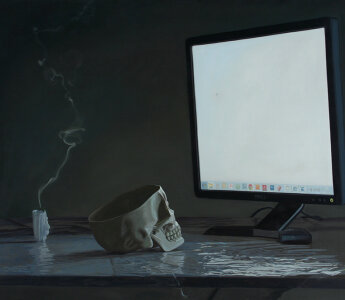
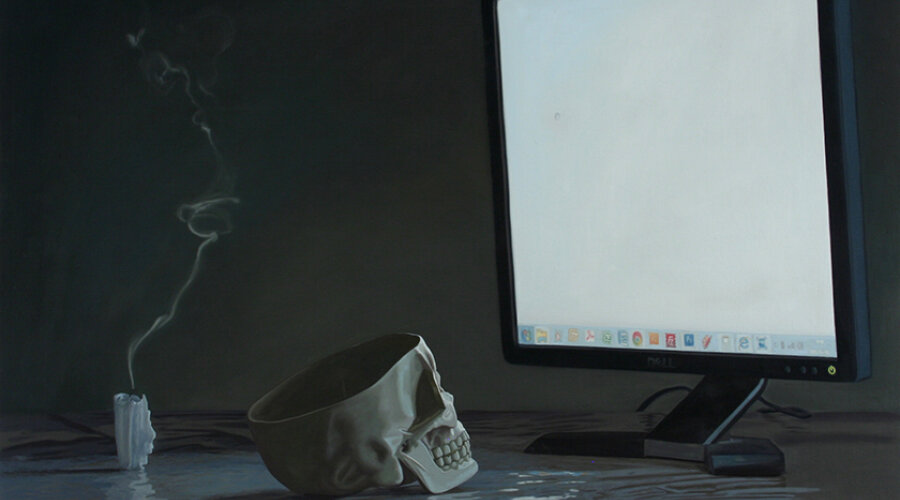
The painting "Memento Vastum" by Julien Boily—an oil on board—tells us of a lost memory. Vastum (“waste” in Latin) refers to the notion of loss, to what is left behind in favor of a certain idea of progress. The tension between tradition and progress fuels this idea of multifaceted loss in the work of Boily. Loss of know-how, artistic certainly, but also of traditional knowledge immediately replaced by new—often in the form of information or even data. It is a recursive dynamic that is constantly accelerating. With the arrival of novelty, what preceded tends to be evacuated. This notion of vestige crosses, in the work, those of programmed obsolescence and vanity. If in the 17th century the mirror was a recurring element in the composition of vanities—these still lifes evoking the ephemeral character of humanity—today, our electronic devices and computer tools could fulfill the same function. Among these objects that send us the reflection of our desires, our fears and our vanity, is not the Internet like a two-way mirror?
Julien Boily (CA): "Memento Vastum", 2012
oil on board, 122 x 152 cm (48″ x 60″)
Julien Boily (CA)
Inspiriran djelima starih majstora zlatnog doba (17. stoljeće), Julien Boily mijenja slikarske kodove toga razdoblja kako bi prikazao suvremene prizore. Odustaje od svake težnje za formalnom inovacijom i koristi slikarstvo u njegovoj izvornoj funkciji predstavljanja stvarnosti. Slika tako sudjeluje u djelu kao samostalan semantički element, uz ono što je prikazano na samim platnima.