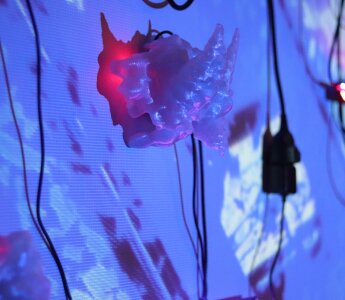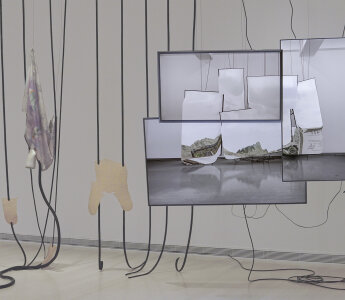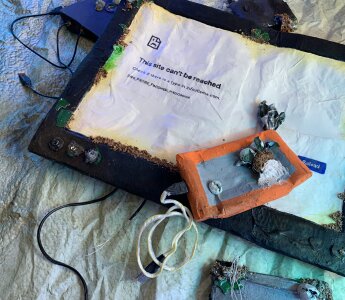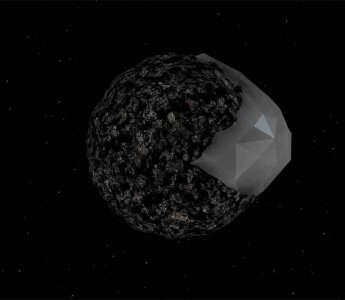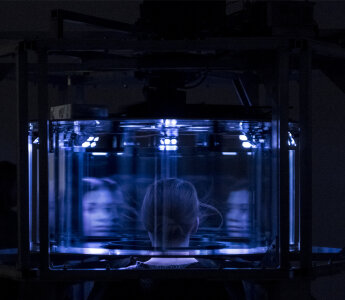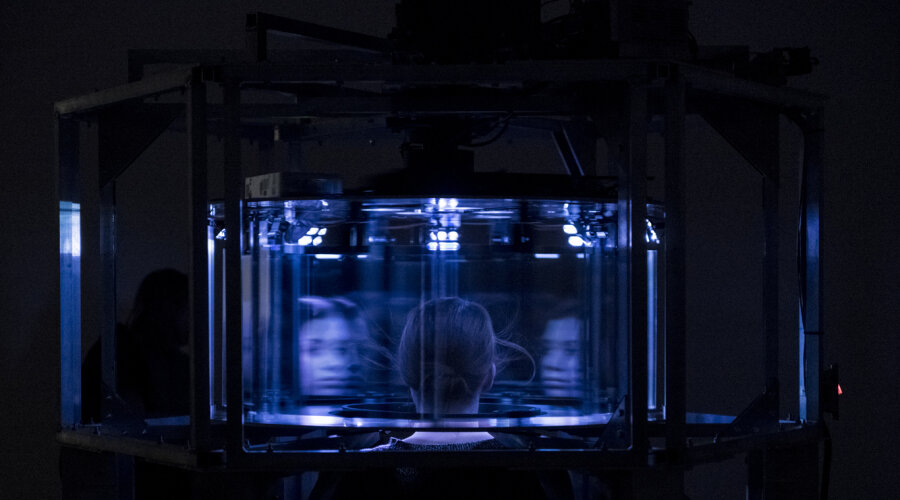
The disorganization of the world by financial capitalism, uprooted and volatile, in part fostered the emergence of the Internet. This network has gradually become the matrix through which our communities and individualities have restructured their exchanges. The promise of a greater flow of ideas, increased freedom, and even new forms of citizenship, now comes up against the power of capital and the dislocated and entropic nature of such a technological arrangement. "The Object of the Internet" is a kinetic installation by Projet EVA (Etienne Grenier and Simon Laroche), evoking the idea of a mausoleum conjuring the end of the Web. Through optical and kinetic processes integrated into a device in which the visitor inserts his head, the human face is broken down into a multitude of fragments. Visitors are projected into a dystopian future where, on social media, only the traces of our selfies, which are artificially animated, remain in the form of a reflection. The latter, condemned to the status of a sterile solipsism, agitates in a sidereal void of the end of the Internet.
The epitaph of the monument-mausoleum: “I have seen many people spill their guts on–line, and I did so myself until, at last, I began to see that I had commodified myself.”
–Carmen Hermosillo, poet, blogger and pioneer of the social Internet, 1994
The creation of "The Object of the Internet" was made possible thanks to the financial support of the Conseil des arts et des lettres du Québec.