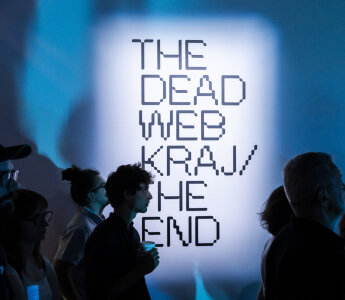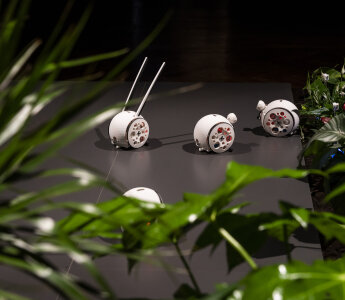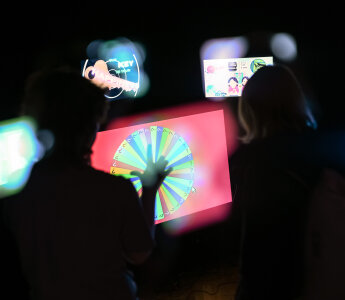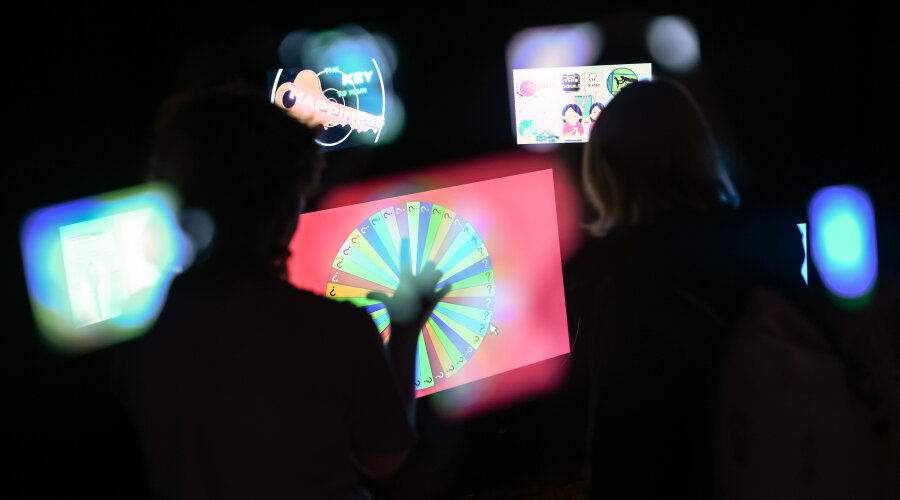
From 5 to 14 March 2026, KONTEJNER hosts an exhibition of works created within the educational art-research project "Matrixes: Happiness" of the Academy of Fine Arts, University of Zagreb.
Exhibiting students: Rogelio Acevedo Medina, Marija Jakupanec, Paula Kepe, Nika Lamešić, Nikolina Marušić, Vid Pavlić, Elena Poljuha, Mihaela Spiegl
Project leaders and mentors: prof. art. Ines Krasić, prof. dr. art. Mirjana Vodopija, doc. art. Iva Ćurić
The educational art-research project Matrixes has been held since 2016, and each year it thematically focuses on a specific segment of the concept of the matrix within the expanded field of art and science.
The central activity of the project "Matrixes: Happiness" took place in July 2025 at the Kuća Klajn in Klanjec. During the field course, scientists and professors from the constituent faculties of the University of Zagreb — assoc. prof. dr. sc. Dario Bojanjac (FER), assist. prof. dr. sc. Višnja Pentić (ADU), assoc. prof. art. Igor Ruf (ALU), and artist Sven Stilinović — gave lectures, workshops, and presentations on the topic of happiness.
The new knowledge acquired through participation in the project enables participants to understand the contemporary artistic, cultural, and social context in which happiness plays a key role, expanding the potential for analytical and critical thinking as well as creativity. During the autumn of 2025, in collaboration with mentors and lecturers, the project participants conceptually developed and realized artworks on the theme of Happiness across a broad range of meanings, from “luck” to “happiness.”
Happiness as a Figure of the Open
Happiness, like any abstract noun, conceals an infinite play of meanings and signification, connotations and associations. Happiness, like beauty, lies in the eye of the observer who determines which of its aspects is indispensable. In the first part of his book Metaphysics of Real Happiness (Métaphysique du bonheur réel, 2015), the French philosopher Alain Badiou describes three basic approaches to the concept of happiness in contemporary philosophy. The phenomenological and hermeneutic current, whose leading representatives are Martin Heidegger and Hans-Georg Gadamer, describes it as a desire for illumination, that is, as a subjective figure of the Open. The analytic current, stemming from Ludwig Wittgenstein, sees real happiness as an affect of democracy, while the postmodern current embodied in the works of philosophers such as Jacques Derrida and Jean-François Lyotard understands happiness as the desire to discover new forms of life and enjoyment within them. Badiou himself emphasizes that today happiness is often reduced to its semblance, manifested as consumer satisfaction, since in the materially and narcissistically conceived narratives of the Western world happiness appears as an identity imperative. On the wings of liberal capitalism without alternatives, it is primarily conceived as a one-time pleasure — an ultimate product we can consume.The participants of this year’s Matrixes, whose theme was happiness, were less concerned with establishing their own definition of the phenomenon and instead directed their energy toward questioning the definitions and ideas of happiness surrounding them, as well as exploring the places where happiness might be encountered. For that is precisely where the catch lies — or perhaps where Kairos’s forelock can be grasped! In these works, happiness does not appear as a product of a system or of personal will available for single-use consumption, but rather as a site of temporary and often unexpected openness in an encounter with a world in constant change. When its aims include the category of encounter, the human search for happiness lies somewhere between imagination and action. The desire of the young artists seems directed toward the same goal as the phenomenological philosophical current — toward the brief and sweet meeting of the possible and the impossible in our here and now, reached both from the past and from the future.
- doc. dr. sc. Višnja Pentić
Organisation: KONTEJNER & Academy of Fine Arts, University of Zagreb
Technical realisation: Jakov Habjan
PR and social media: Inesa Antić
Design: Kuna zlatica
Reproduction: Nika Lamešić
Supported by: Grad Zagreb, Ministarstvo kulture RH, Zaklada Kultura nova, Nacionalna zaklada